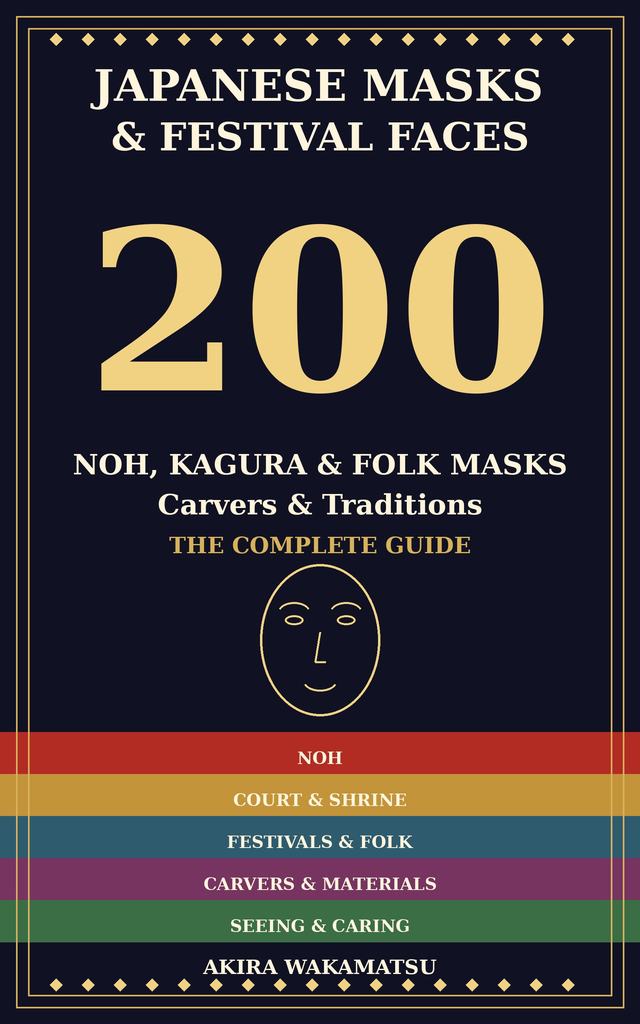
Japanese Masks & Festival Faces
The Complete Guide to 200 Noh, Kagura & Folk Masks, Carvers & Traditions
- AuthorAki Wakamatsu
- PublisherTakikawa TOKOTOKO Kids LLC
- CategoryJapan Guides & Culture
- LanguageEnglish
- FormatEPUB ebook
About this book
A museum caption gives you a name and a century. A specialist monograph gives you one art. Japanese Masks & Festival Faces does the missing job: 200 Japanese masks — noh and kyogen faces, bugaku and gigaku survivors, kagura gods and demons, visiting gods, lion heads, daruma and the iron faces of armour — plus their carvers, regions and materials, in one uniform format, every entry giving Origin & Tradition, Carving & Materials, Face & Expression, and Seeing, Buying & Care, each entry written in full at 350+ words.
The young women and old men of the noh stage, the whistling fools of kyogen, the paper demons of Iwami kagura that weigh almost nothing, the straw-clad Namahage at the farmhouse door — and behind them the Deme and Zekan carving houses, Sekishu washi, gofun shell white, gold-mud eyes, paulownia boxes and the whole material world of the mask maker's bench, treated honestly, including the masks that are not for sale at any price.
A front chapter teaches you to read a mask in four checks — carving, eyes, mouth, and the tilt that changes grief to calm. There are no photographs: the faces are taught in words, for the eye, because these masks reward readers who know what they are looking at. Prices, stock and schedules are never asserted; every entry asks you to confirm them on the maker's, troupe's, shrine's, museum's or shop's official channel.
Written and created in Japan by Japanese author Aki Wakamatsu. Published by Takikawa TOKOTOKO Kids LLC, a Japanese publisher in Hokkaido, Japan. Authentic Japanese content, carefully made in Japan — not mass-produced.