Japanese Workbook Vol.25
Environment & Sustainable Living Japanese
Series: Japanese Workbook · Vol. 25
- AuthorAki Wakamatsu
- PublisherTakikawa TOKOTOKO Kids LLC
- CategoryJapanese Workbooks
- FormatEPUB ebook
About this book
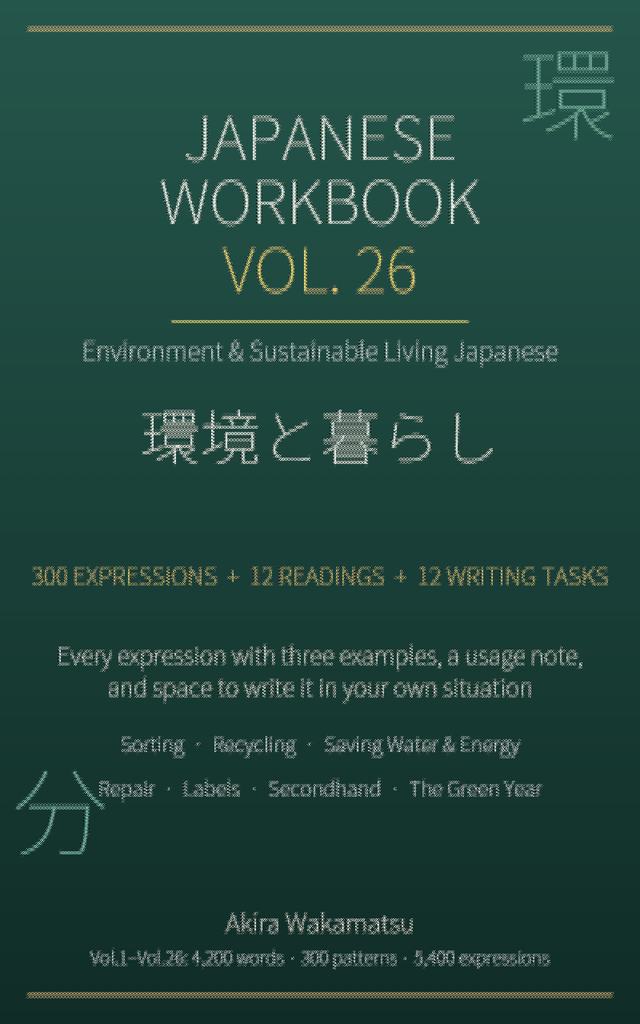
Japanese Workbook Vol.26: Environment & Sustainable Living Japanese — The Japanese of Sorting, Saving and Using Things Long
The collection morning you must never miss. The sorting table you must read before the bag goes out. The meter slip you must read without anxiety. The broken handle you must describe in the right order at the repair counter. The mark on the label you must understand before you obey it. If your home in Japan runs on the collection calendar, this is the Japanese that life runs on — and it cannot be improvised at the collection point.
Part 1 — 300 practical expressions in 20 scene groups Sorting the waste, recycling and where resources go, cutting waste down, saving water at home, saving electricity and gas, repair and mend, passing things on, food without waste, shopping for keeps, reading the labels and marks, the home's energy, moving lightly, the local cleanup, promises in nature's places, green habits at school and work, talking about the environment, secondhand and swaps, saving through the seasons, asking and learning, and the green year. Every expression includes its reading, romaji, English meaning, a usage note (the scene, the care to take, the rule to remember, the words to confirm), three example sentences in Japanese and English, and a ruled practice space for three sentences of your own.
Part 2 — 12 writing tasks in three stages Short notes (asking family to take the waste turn, inviting a friend to the local cleanup day, telling family how you want the shopping done, passing a thing you no longer use to a friend), messages that handle a situation (telling the repair desk the state of an article, a call for joiners to the cleanup in the local circular, asking the shop staff about a label you do not understand, telling family how a month of saving water and electricity went), and full written pieces (a year of our house's efforts looked back over, a local environmental event introduced, a precious thing used for long, next year's aim) — each with a model answer that really uses this volume's expressions, a self-check list and a full writing grid.
Part 3 — 12 readings on the environmental home The rules for sorting and putting out household waste, how recycling works and where resources go, reading and checking the guides for saving water and electricity, buying and storing food so nothing is wasted, asking for repairs and collecting them, the meanings of environmental labels and marks, the notice for the local cleanup day, the promises and rules for walking in places of nature, choosing secondhand goods, how the home's energy is used and reviewed, enjoying environmental events and places of learning, and looking back over a year of living — each with a full translation, five key words and three comprehension questions.
Series integrity: zero overlap, no exceptions All 300 expressions and all 12 reading titles were checked item by item against everything in Vol.1–Vol.25 (9,600 headwords and 300 reading titles): overlap zero. Across the twenty-six volumes you now train 4,200 words, 300 sentence patterns, 5,400 practical expressions and 312 readings. One honest note: sorting rules, charges and customs differ by town, shop and season — this book teaches you to say so and to confirm, and it is a language workbook, not a book of environmental policy or product guidance: it teaches you to sort, to save, to repair and to ask, and leaves the arguing of policies to their makers.
For learners who have finished Vol.1–Vol.25 or who already read and write Japanese at an advanced level — and above all for anyone whose home in Japan runs on the collection calendar, the meter slip and the repair counter.