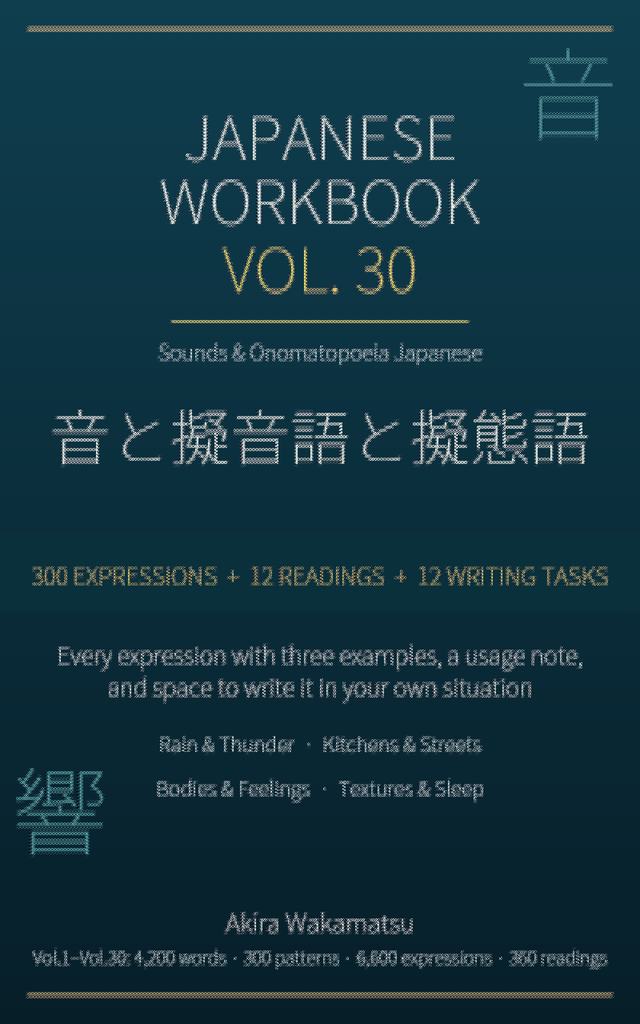
Japanese Workbook Vol.30
Sounds & Onomatopoeia Japanese
Series: Japanese Workbook · Vol. 30
- AuthorAki Wakamatsu
- PublisherTakikawa TOKOTOKO Kids LLC
- CategoryJapanese Workbooks
- FormatEPUB ebook
About this book
Japanese Workbook Vol.30: Sounds & Onomatopoeia Japanese — The Japanese Your Ears Already Know
The rain that taps and the rain that roars are different rains in Japanese, and the words for them are different words. The pot that whispers and the pot that rolls are at different stages of cooking. The pain that throbs, the pain that zings and the pain that aches in waves are three different reports at the clinic desk, and only one of them is true of your body today. If you live in Japan, your ears already hear all of this — this is the workbook that gives your mouth and your hand the words for it: sound words and state words, the largest and most Japanese corner of the language, taught as writing practice, not as a list to admire.
Part 1 — 300 practical expressions in 20 scene groups Rain sounds from a drip to a downpour, wind and storm sounds, water sounds, thunder, snow and the changing sky, animal voices, kitchen and cooking sounds, eating and drinking sounds, household sounds, street and town sounds, festival and celebration sounds, body sensations, aches and unwell days, feelings that lift, feelings that grate, faces and laughter, textures and touch, shine and appearance, movement and speed, work and study states, and sleep, rest and quiet. Every expression includes its reading, romaji, English meaning, a usage note (the scene, the degree the word points to, the words to compare it with, the care to take), three example sentences in Japanese and English, and a ruled practice space for three sentences of your own.
Part 2 — 12 writing tasks in three stages Short pieces about the sounds around you (the sounds of rain written in a letter, the sounds of a meal in a diary, the feelings of the body noted down, the state of your sleep), messages that handle a situation (telling the family how the cooking is going, saying by telephone that you are unwell, reporting a visit to the zoo, giving directions with the sounds of the town), and full written pieces (the events of a happy day, the goodness of a touch written into an introduction of goods, a day of storm and snow, looking back over the movements of a journey) — each with a model answer that really uses this volume's expressions, a self-check list and a full writing grid.
Part 3 — 12 readings on sounds and state words A guide to listening for the differences in rain sounds, an explanation of how to learn sound words and state words, a guide to knowing how cooking advances by its sounds, an explanation of how animal cries are written in Japanese, a guide to the drums and bells of the festival, a guide to telling pain in sound words, an explanation of how to read sound letters in manga, an explanation of town sounds and the edge of quiet, a guide to the beginnings of children's words and sounds, a guide to a way of living that enjoys rainy-day sounds, an explanation of words for work and study going well, and a guide to words for sleep and stillness — each with a full translation, five key words and three comprehension questions.
Series integrity: zero overlap, no exceptions All 300 expressions and all 12 reading titles were checked item by item against everything in Vol.1–Vol.29 (10,800 headwords and 348 reading titles): overlap zero. Across the thirty volumes you now train 4,200 words, 300 sentence patterns, 6,600 practical expressions and 360 readings. One honest note: the same sound is not heard the same way in every house, and where people differ this book teaches you to ask rather than assuming. It is a language workbook, not a medical guide: it teaches how to describe a sensation, and it claims no diagnosis and no treatment for anything.
For learners who have finished Vol.1–Vol.29 or who already read and write Japanese at an advanced level — and above all for anyone who wants to say what they hear, what they feel and how things are, in the words Japanese reaches for first.