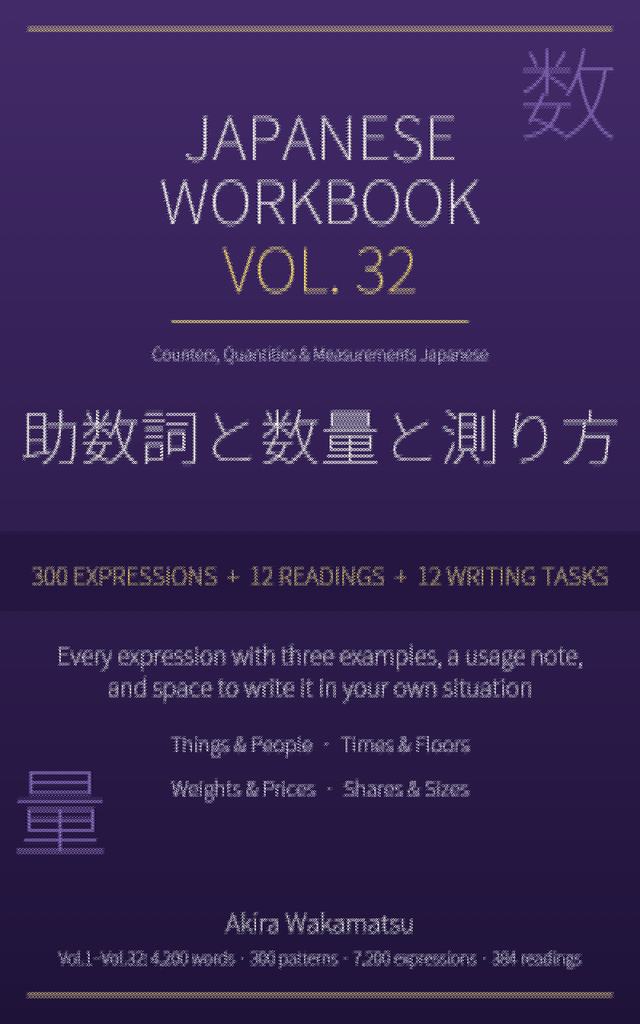
Japanese Workbook Vol.32
Counters, Quantities & Measurements Japanese
Series: Japanese Workbook · Vol. 32
- AuthorAki Wakamatsu
- PublisherTakikawa TOKOTOKO Kids LLC
- CategoryJapanese Workbooks
- FormatEPUB ebook
About this book
Japanese Workbook Vol.32: Counters, Quantities & Measurements Japanese — Count It Right, Measure It True, Share It Fairly
Six eggs or ten? A bottle, a sheet, a tail of fish — Japanese counts nothing with a bare number, and the counter changes its sound as the number changes: ippon, nihon, sanbon. Learners meet the counter table early and still freeze at the market stall years later, because a table is not a sentence. This is the workbook that trains counting and measuring the way the series trains everything — by writing them, in your own situations, until the right counter is ready before the basket is full.
Part 1 — 300 practical expressions in 20 groups Counting things: small and round things, flat and thin things, long and slender things, machines, vehicles and furniture, and books, copies and pages. Counting life and time: people and their ages, animals, birds and fish, times, floors and nights away, lengths of time, and dates, order and sets. Measuring the world: length, height and distance, weight and servings, liquids, cups and spoonfuls, size and fit, and money, percentages and discounts. Amounts in real life: rough and approximate amounts, more, less and enough, multiples and sharing out, kitchen cuts, bunches and heads, and buildings, rooms and cases. Every expression includes its reading, romaji, English meaning, a usage note (the scene, the care to take, the rule to remember), three example sentences in Japanese and English, and a ruled practice space for three sentences of your own.
Part 2 — 12 writing tasks in three stages Short notes daily counting runs on (a note of the numbers in shopping, describing the family and the animals, writing a travel plan briefly, weighing the vegetables and the rice), messages that handle a situation (estimating roughly and doubling the recipe, counting the tools and the rooms, weighing and measuring a parcel, splitting the price of a present), and full written pieces (dividing the jobs by rota, describing a flat by its numbers, writing down what is used in one day, a shopping list for the class party) — each with a model answer that really uses this volume's expressions, a self-check list and a full writing grid.
Part 3 — 12 readings in the genres of counting and measuring's documents An explanation of how the counter system works, a guide to counting people and saying their ages, an explanation of counting animals, birds and fish, an explanation of the words for weight and amount in shopping, a guide to cooking quantities and the size of one serving, an explanation of the words for length, height and distance, a guide to the words for stretches of time and numbers of times, a guide to using the words of money, discounts and percentages, a guide to choosing words for approximate amounts, an explanation of the words for size, a guide to counting buildings and vehicles, and an explanation of sharing out and multiples — each with a full translation, five key words and three comprehension questions.
Series integrity: zero overlap, no exceptions All 300 expressions and all 12 reading titles were checked item by item against everything in Vol.1–Vol.31 (11,400 headwords and 372 reading titles): overlap zero. Across the thirty-two volumes you now train 4,200 words, 300 sentence patterns, 7,200 practical expressions and 384 readings. One honest note: the right counter differs with the shape of the thing counted and the use it is put to, and where people differ this book teaches you to choose rather than assuming one counter fits all. It is a language workbook, not a book of weights and measures law and not a shopkeeper's manual: it teaches the living forms, and it promises no exact weight, no bargain and no fair division.
For learners who have finished Vol.1–Vol.31 or who already read and write Japanese at an advanced level — and above all for anyone who shops, cooks, travels or lives in Japan and wants their numbers to come out right the first time.